
“In the past two hundred years, European missionaries have given much attention to studying the cultures of non-European people with a view to communicating the gospel to them. They have unfortunately not given so much time to understanding this (Western) culture within which the gospel has been so long domesticated. And this is a very, very difficult undertaking, a very painful undertaking.”—Lesslie Newbigin, A Word in Season
When I scroll through my Facebook feed, I eventually see an ad promising to help churches increase attendance, preach more effective sermons, attract young families, reach the next generation, or finally break through whatever barrier is keeping them from growing.
Some promise even more: fulfill the Great Commission. Transform your community. Change the world. And every time I see one, I drop my head and sigh. It isn’t because I question the desire behind them. I believe their intention is good, but the idea underneath it is misguided.
After more than three decades of ministry, I still want to see people come to Christ. I want churches to flourish. I want pastors to preach faithfully and effectively. I want the next generation to know Jesus. And I want the church to participate in God’s mission in the world.
Their zeal is welcome, and their pursuit is noble. But increasingly, I wonder whether some of our expectations — and the methods we’ve built around them — rest upon assumptions that simply aren’t true.
What if our biggest problem isn’t that we haven’t found the right strategy yet, but something much different? What if we are simply looking at the wrong map?
Changing the World
Several years ago, I read James Davison Hunter’s influential book To Change the World. Hunter’s thesis is difficult to argue: Christians want to see the world transformed, but rarely see it happen, because they don’t know how culture works.
Christians have rarely been indifferent toward the world around them. Across Christian history, believers have built schools and hospitals, founded ministries and institutions, cared for the poor, evangelized their neighbors, engaged politics, created art, pursued justice, and sought to shape the cultures in which they lived.
“To be a Christian is to be obliged to engage the world, pursuing God’s restorative purposes over all of life, individual and corporate, public and private.”—James Davison Hunter.1
The problem, Hunter argues, isn’t the desire to make a difference. It’s our understanding of how change actually happens. He examines the assumptions behind many Christian attempts at cultural transformation and reaches a rather unsettling conclusion: many of our strategies don’t merely fail because we’ve executed them poorly. They rest upon a faulty understanding of culture itself.
That’s a much deeper problem.
If your strategy is wrong, you can change your strategy. But what happens when the assumptions underneath your strategy are wrong? You have to redraw the map.
California Is an Island?
For more than a century, European maps of North America routinely depicted California as an island. The strange thing is that earlier maps had gotten it right. California had been mapped as part of the North American mainland. But during the seventeenth century, reports began circulating that seemed to confirm something European explorers desperately hoped to find: a water passage through North America connecting the Atlantic and Pacific.
Before long, California began appearing on maps as an enormous island separated from the continent. Then something fascinating happened. Other mapmakers copied it. One map influenced another, which influenced another, until the mistake became established. The map began exercising power over how people interpreted the territory.
The people making these maps weren’t stupid. Nor had exploration stopped. New information continued to arrive. But that information was interpreted through a picture of the world that people had already accepted. California was an island. And when you already know California is an island, whatever you discover has to somehow fit that map.
Eventually, the evidence became overwhelming. California wasn’t an island. It never had been. The territory hadn’t changed. The map had. And that distinction matters far beyond cartography.
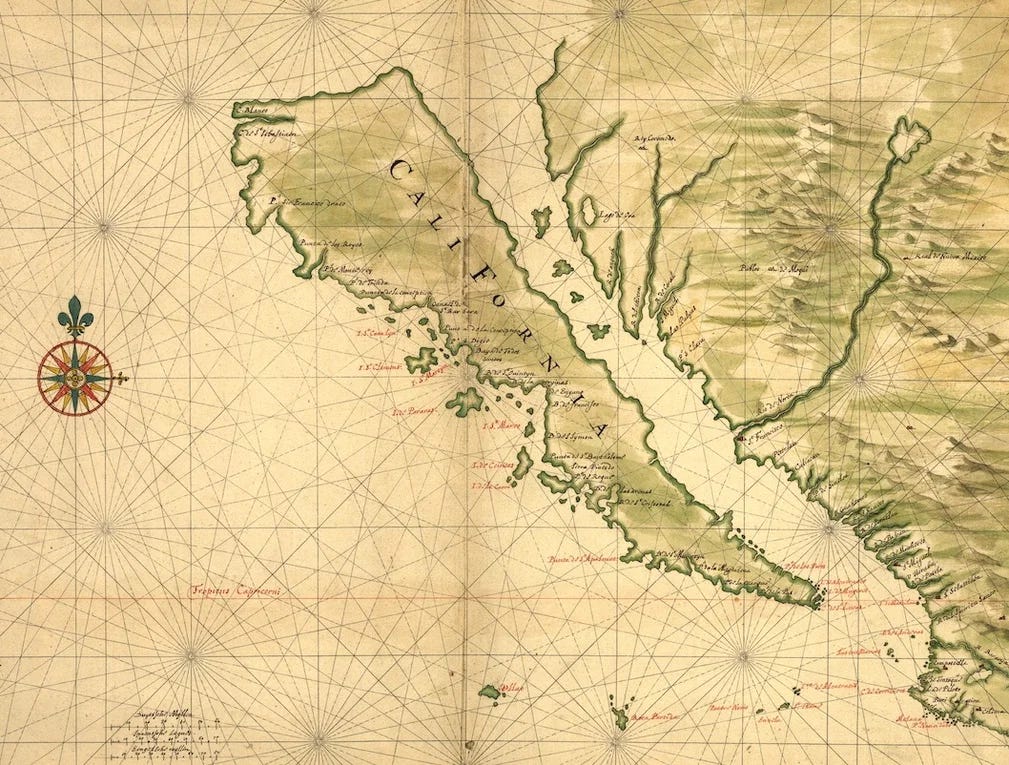
Map of California as an island, by Joan Vinckeboons, ca. 1650 — Source.
The Maps We Carry
Every one of us carries maps in our heads. They tell us what the world is like, how it works, what’s important, what success looks like, what human beings need, where we should be going, and how we should get there.
Most of the time, we don’t even realize we’re carrying them. We have maps for everything: marriage, family, money, success, politics, education, and for happiness and the good life. And we have maps for ministry.
If you’ve spent much time around the North American church, you’ve probably absorbed some version of one. Find a gifted preacher. Build an excellent worship ministry. Create relevant programs. Develop good systems. Provide a great children’s ministry. Remove barriers. Meet people’s needs. Get the right people in the right seats. Learn what growing churches are doing and adapt it to your context.
Do those things well enough and people will come. If people come, the church will grow. If the church grows, more people will hear the gospel. And if enough churches do that, perhaps we can transform the culture.
There are good things in that list. We should have good preaching, churches should care about children, and leaders should develop healthy systems. We should remove unnecessary barriers to people hearing the gospel. Excellence isn’t the enemy. The question is deeper than that.
What assumptions about God, the gospel, the church, mission, culture, and success are hiding underneath our methods? Because methods are never just methods. They emerge from a way of seeing the world. And that way of seeing can become so familiar that we stop recognizing it as a map at all. We simply assume that it is reality.
Field of Dreams
For a long time, many of our ministry maps seemed to work. The prevailing mindset was reminiscent of Field of Dreams: “If you build it, they will come.” Build the facility. Offer compelling preaching, excellent programs, engaging worship, and ministries for every member of the family, and people will come.
And for a time, many did.
But that approach operated in a culture where people largely knew what a church was. Even those who didn’t attend understood much of its vocabulary. They knew who Jesus was. They had categories for sin, salvation, prayer, the Bible, and church. Christianity still occupied a recognizable place in the culture.
But what happens when the culture changes and the map doesn’t?
Something has changed. Pastors know it. Parents know it. Church leaders know it. The territory no longer looks like the map. And our instinct when that happens is often to work the old map harder: improve the preaching, upgrade the worship, start another program, update the website, hire the consultant, and rebrand the church. If we can just find the strategy that is working for others and make it work for us, then everything will be ok. And if the results aren’t coming in the way that they do for others, then execution must be our problem.
But what if it isn’t? What if we are standing on the mainland staring at a map that still insists California is an island?
Big, Fast, and Famous
Pastor and author Zack Eswine has observed that American ministry has a peculiar temptation: we want the kingdom of God to come big, fast, and famous. Those words expose something. Because when Jesus described the kingdom of God, he often used very different images: A mustard seed.
Yeast hidden in dough. Seed scattered on soil. Treasure buried in a field. A farmer who goes to sleep and wakes up while the seed grows, though he doesn’t know how.
It’s small, slow, and hidden. That doesn’t mean the kingdom never becomes visible or large. A mustard seed becomes a tree, and yeast eventually works through the dough. But Jesus’ images challenge our instincts about how God’s work happens. And perhaps that should cause us to ask some uncomfortable questions: Where did our instincts come from? Why do we assume bigger means healthier? Why does faster seem more successful? Why do numbers so easily become our measure of fruitfulness? Why do influence, visibility, platforms, efficiency, and scale feel so natural to us?
I would love to believe that those assumptions came from Scripture, but it seems to me that some of them come from somewhere else, and if we don’t ask the right questions, then we will never really see.
Learning to See
That brings us back to the missionary Lesslie Newbigin (1909 – 1998), who served in India for almost 40 years before returning to the UK to find a culture that had become post-Christian. Newbigin noted that for generations, Western missionaries traveled around the world and did something remarkable. Before they could communicate the gospel faithfully, they tried to understand the people to whom they had been sent. And that meant studying language, customs, religions, stories, rituals, social structures, assumptions, and learning how they saw the world.
Missionaries understood, at least in part, that communicating the gospel to someone of a different culture required more than translating English words. It required something altogether different– understanding the world into which those words were being spoken.
But Newbigin noticed something strange. Western Christians rarely turned that same missionary attention upon themselves and simply assumed that their culture was right or neutral. They studied other cultures, but assumed their own.
That’s dangerous because the assumptions that are the hardest to see are usually our own. Fish don’t spend much time thinking about water. And we don’t spend much time thinking about the maps in our heads. That’s why perspective matters.
Before we ask how to reach our culture, we should seek to understand it. And before we ask what strategy will grow the church, maybe we need to ask what we think the church is and what it’s for.
And before we try to make the gospel relevant, we should probably make sure that we understand what the gospel actually is. And before we think about changing the world, we need to see and understand how the world has already been shaping us. And before we rush toward another technique, program, model, strategy, or personality, we should stop long enough to look at the map.
I think that we find that reality is not a problem, and California was never an island, but the maps we have inherited certainly are.
Maybe, just maybe, we need to learn to see the world as it is again.
James Davison Hunter, To Change the World: The Irony, Tragedy, and Possibility of Christianity in the Late Modern World (Oxford University Press, 2010), 4.